

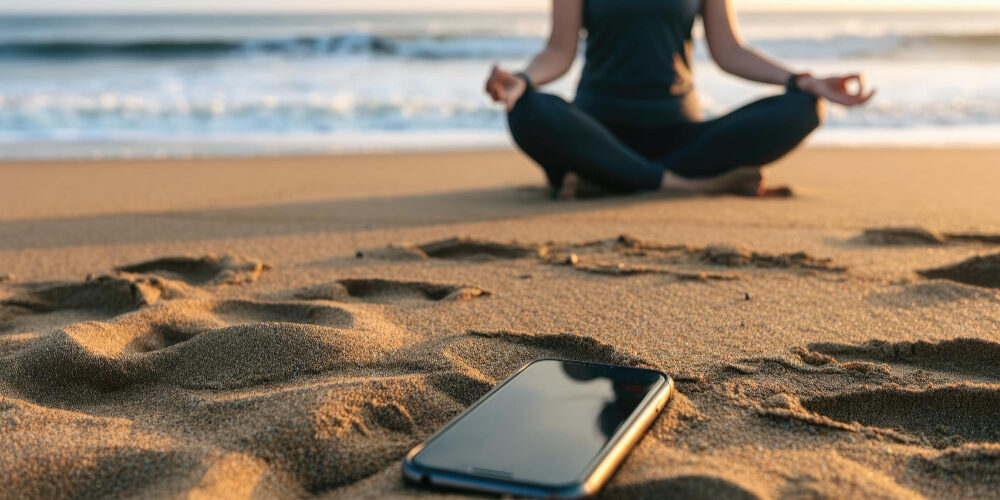
Cortisol, the body’s primary stress hormone, follows a natural daily rhythm — rising sharply in the morning to help us wake up, and gradually declining through the day. In theory. In practice, constant notifications, always-on connectivity, and the low-grade background noise of modern life keep cortisol elevated far more often than the body was designed to tolerate. This is part of why the idea of a “digital detox” has moved from wellness-industry buzzword to something increasingly discussed in physiological terms — and why the setting in which that detox happens matters more than most people assume.
What actually happens to cortisol during a digital detox
Cortisol doesn’t respond only to major stressors. Research on stress physiology has repeatedly shown that repeated, low-level interruptions — a notification here, an email there — keep the nervous system in a mild but persistent state of alert, a pattern sometimes described as “continuous partial stress.” Over time, this can blunt the natural rhythm cortisol is supposed to follow, keeping levels higher than they should be at rest, and lower than they should be at the moments the body needs an energy boost.
Removing those interruptions doesn’t instantly reset the system, but it does remove the trigger. Several studies on structured digital-detox periods have found measurable reductions in self-reported stress and, in some cases, physiological stress markers, typically within just a few days of reduced device use.
Why environment matters as much as the decision to disconnect
Deciding to put your phone away is one thing. Actually doing it consistently is another, and the environment plays a large role in which of those two outcomes wins. A hotel room next to a busy pool, with visible Wi-Fi prompts and constant ambient noise, works against the intention almost as much as an inbox does. A private, quiet setting removes much of the friction — there’s simply less pulling attention back toward a screen.
This is one of the less-discussed advantages of all-suite, adults-only resorts such as Lesante Blu Exclusive Beach Resort in Zakynthos, where every suite includes a private pool and the general layout is built around seclusion rather than shared, high-traffic spaces. The absence of children’s activity areas, crowded common pools, and the general noise of a full-capacity resort isn’t just a lifestyle preference — it removes several of the ambient stimuli that keep the nervous system mildly activated even when a guest isn’t consciously checking their phone.
Sleep, light, and the other half of the cortisol equation
Cortisol recovery isn’t only about removing stressors during the day — sleep quality plays an equally large role, since cortisol’s daily rhythm is closely tied to the sleep-wake cycle. Noise, light pollution, and irregular schedules all interfere with that rhythm. A quieter physical environment, away from nightlife and heavy foot traffic, tends to support more consistent sleep timing, which in turn supports a more normalized cortisol curve. This is a structural advantage of the kind of location Lesante Blu occupies — the northeast coast of Zakynthos near Tragaki, well away from the island’s busier southern strip — rather than something that can be replicated through willpower alone in a noisier setting. It’s also consistent with a broader pattern worth understanding: why adults-only resorts, specifically, tend to support mental health more reliably than mixed-occupancy properties since removing one major source of unpredictable ambient noise has a similar stress-reduction effect to removing digital noise.
Privacy as a practical, not just aesthetic, feature
Privacy is often framed as a luxury amenity, but from a stress-physiology standpoint it functions more like a practical tool. Knowing that a private pool, a private terrace, or a private dining space is genuinely private — not merely quiet at certain hours — removes another low-level source of social vigilance that, while minor on its own, adds to overall stress load when sustained over days. This kind of environment is part of a broader shift in what travelers are looking for from an island escape altogether — the same instinct behind why Zakynthos is emerging as one of Greece’s most exclusive island retreats, rather than automatically defaulting to louder, more crowded destinations. All-suite layouts, where privacy isn’t limited to a handful of premium room categories, extend that benefit to every guest rather than only those who book the top tier.
What this means for planning a genuine reset
For travelers specifically looking to lower stress rather than simply relax in the conventional sense, a few practical factors seem to matter most based on what the research on digital detox and cortisol suggests: genuine physical privacy, minimal ambient noise, a setting that doesn’t require active effort to avoid screens, and a sleep environment free of light and sound disruption. A resort built around those factors from the ground up tends to make the process considerably easier, which matters, since consistency is what ultimately drives the physiological benefit.
None of this replaces professional medical guidance for anyone dealing with chronic stress or a diagnosed condition — but for the more common experience of simply feeling “wired” after months of constant connectivity, the combination of silence, privacy, and a genuinely disconnected setting appears to do real physiological work, not just create the impression of rest.
Μιχάλης Γεωργιάδης
Συντάκτης Ιατρικού Περιεχομένου: Ο Μιχάλης Γεωργιάδης είναι επαγγελματίας συντάκτης με εμπειρία σε ιατρικά, διαγνωστικά και χειρουργικά θέματα. Με βαθιά γνώση της ιατρικής ορολογίας και με στόχο την αξιοπιστία της πληροφορίας, επιμελείται άρθρα που ενισχύουν την εικόνα και την εξειδίκευση των ιατρών στο ελληνικό διαδίκτυο.