

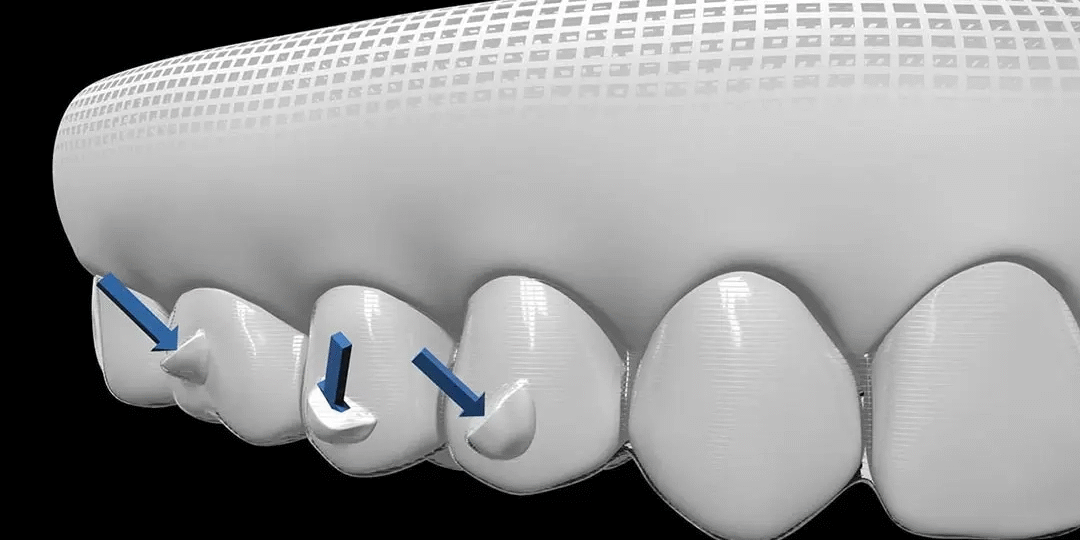
Clear aligner therapy has revolutionized the world of orthodontics, offering a discreet and comfortable alternative to traditional metal braces. However, many patients are surprised to learn that clear does not always mean invisible. If a patient is starting their journey toward a straighter smile, they will likely encounter Invisalign attachments. While the aligners themselves do the heavy lifting, these tiny components are the unsung heroes that ensure complex tooth movements happen efficiently and predictably.
Understanding how these small additions function, why they are necessary, and what to expect during daily life is crucial for any patient seeking optimal results. This comprehensive article explores every facet of these orthodontic auxiliaries to demystify the process.
What are Invisalign attachments?
Invisalign attachments are small, tooth-colored bumps made of dental composite resin, the same material used for dental fillings. Before the first set of trays is delivered, a dentist or orthodontist strategically bonds these shapes to specific teeth.
The primary purpose of an attachment is to provide a handle for the aligner to grip. Because teeth are naturally smooth and often conical or rounded, a plastic tray can sometimes slip or fail to exert the necessary leverage to move a root. By adding a precise, geometric shape to the surface of the tooth, the aligner can click into place and apply force in a specific direction that would otherwise be impossible with the aligner alone.
These shapes vary depending on the required movement. Some are circular, while others are rectangular, triangular, or even pill-shaped. They are designed to be as unobtrusive as possible, matching the natural shade of the patient’s enamel so they remain relatively discreet when the aligners are removed.
Might interest you: How to fix an underbite: Causes, treatment options & what to expect
How do Invisalign attachments work?
To understand how invisalign attachments function, one must look at the physics of tooth movement. Orthodontics relies on the application of constant, gentle pressure to remodel the bone surrounding the tooth roots.
- Force Application: A standard clear aligner works well for tipping or leveling teeth. However, for more complex movements, such as rotating a rounded canine or extruding (pulling) a tooth further out of the gum line, the aligner needs an anchor point.
- Geometric Precision: Each attachment is placed at a specific angle. When the aligner is worn, it features a small “dimple” or “pocket” that fits perfectly over the resin bump. The pressure from the plastic pushing against the flat surface of the attachment creates a directional force.
- Predictable Results: Without these anchors, certain teeth might lag, meaning they do not move as fast as the software predicted. Attachments minimize this lag, ensuring the treatment stays on schedule and reduces the need for refinements (extra trays) at the end of the process.
Essentially, they transform a passive plastic tray into an active orthodontic tool capable of 3D control over each individual tooth.
The placement process: What to expect at the clinic with invisalign attachments
Many patients feel anxious about having bumps glued to their teeth, but the procedure is entirely non-invasive and painless. No needles or drilling are required.
- Tooth Preparation: The orthodontist cleans the tooth surface and applies a mild etching gel. This microscopic roughening of the enamel ensures the composite resin sticks firmly.
- The Template: Instead of placing each bump by hand, a template aligner is used. This is a thin, flexible tray with holes where the attachments should go. The orthodontist fills these holes with composite resin.
- Curing: The template is placed over the teeth, and a high-intensity ultraviolet (UV) light is used to harden the resin instantly.
- Cleanup: Once the template is removed, the resin remains bonded to the teeth. The doctor trims away any excess material and polishes the edges so they feel smooth to the tongue and lips.
The entire process usually takes less than 30 minutes, and the patient leaves the office with their first set of active aligners.
Living with Invisalign attachments: Diet, Hygiene, and Comfort
While the attachments are designed to be convenient, they do require a slight adjustment to a patient’s daily routine.
Eating and Drinking
Since the resin is porous, it can stain. Foods heavy in turmeric, coffee, red wine, or dark berries can cause the attachments to turn slightly yellow or orange. Because the attachments stay on the teeth even when the aligners are removed, patients should rinse their mouths thoroughly after consuming staining agents. Additionally, while the resin is strong, very crunchy or sticky foods (like hard nuts or taffy) can occasionally shear an attachment off the tooth.
Oral Hygiene
The presence of Invisalign attachments creates more “nooks and crannies” where plaque and food particles can hide. It is imperative to brush carefully around each bump. If plaque builds up around an attachment, it can lead to permanent white spots (decalcification) on the enamel once the treatment is finished. Electric toothbrushes are often recommended to ensure the margins of the resin stay clean.
Comfort and Sensation with invisalign attachments
When the aligners are off, the attachments may feel scratchy against the inside of the cheeks or lips. This sensation is most noticeable during the first week. Fortunately, the mouth’s soft tissues “toughen up” quickly (a process called keratinization), and the edges of the attachments naturally smooth out over time through chewing and brushing. If a particular edge is sharp, orthodontic wax can be used to cover it during the transition period.
Might interest you: Invisalign cost: What affects the final price
Common challenges and troubleshooting with invisalign attachments
It is not uncommon for a patient to experience a few hiccups regarding their attachments during the course of a 12 to 18-month treatment.
- The Attachment Falls Off: This is a frequent occurrence. If a bond fails, the patient should contact their clinic. While it is rarely an emergency, the attachment needs to be replaced so the tooth doesn’t stop moving. The orthodontist will simply use the original template to re-bond it.
- Difficulty Removing Aligners: Because the attachments act like “grips,” the aligners will fit much more tightly. Patients may find it difficult to “pop” the trays out for meals. The best technique is to start from the back (near the molars) on the tongue side and work forward. Special removal tools (small plastic hooks) are often provided to help with this.
- Visibility: While the material matches tooth color, the bumps can be visible from certain angles, especially if they are on the front incisors. However, most people find that once the clear aligner is on top, the plastic diffuses the light, making the attachments blend in even more.
Professional guidance and expert care
The success of a clear aligner treatment depends entirely on the precision of the initial plan and the skill of the provider in managing these mechanical aids. Orthodontist in Chalandri and Koropi, Dr. Angeliki Nikolopoulou, who is considered a leading orthodontist specializing in Invisalign treatment, offers specialized expertise in designing customized treatment plans that utilize Invisalign attachments with surgical precision to correct crowding, spacing, and bite misalignments.
By conducting a thorough digital scan and analyzing the specific biomechanical needs of each tooth, she ensures that every attachment is placed only where necessary, maximizing both the efficiency of the movement and the aesthetic comfort of the patient. Her approach focuses on minimizing treatment time while achieving a stable, functional, and beautiful smile through the latest advancements in clear aligner technology.

Μιχάλης Γεωργιάδης
Συντάκτης Ιατρικού Περιεχομένου: Ο Μιχάλης Γεωργιάδης είναι επαγγελματίας συντάκτης με εμπειρία σε ιατρικά, διαγνωστικά και χειρουργικά θέματα. Με βαθιά γνώση της ιατρικής ορολογίας και με στόχο την αξιοπιστία της πληροφορίας, επιμελείται άρθρα που ενισχύουν την εικόνα και την εξειδίκευση των ιατρών στο ελληνικό διαδίκτυο.