

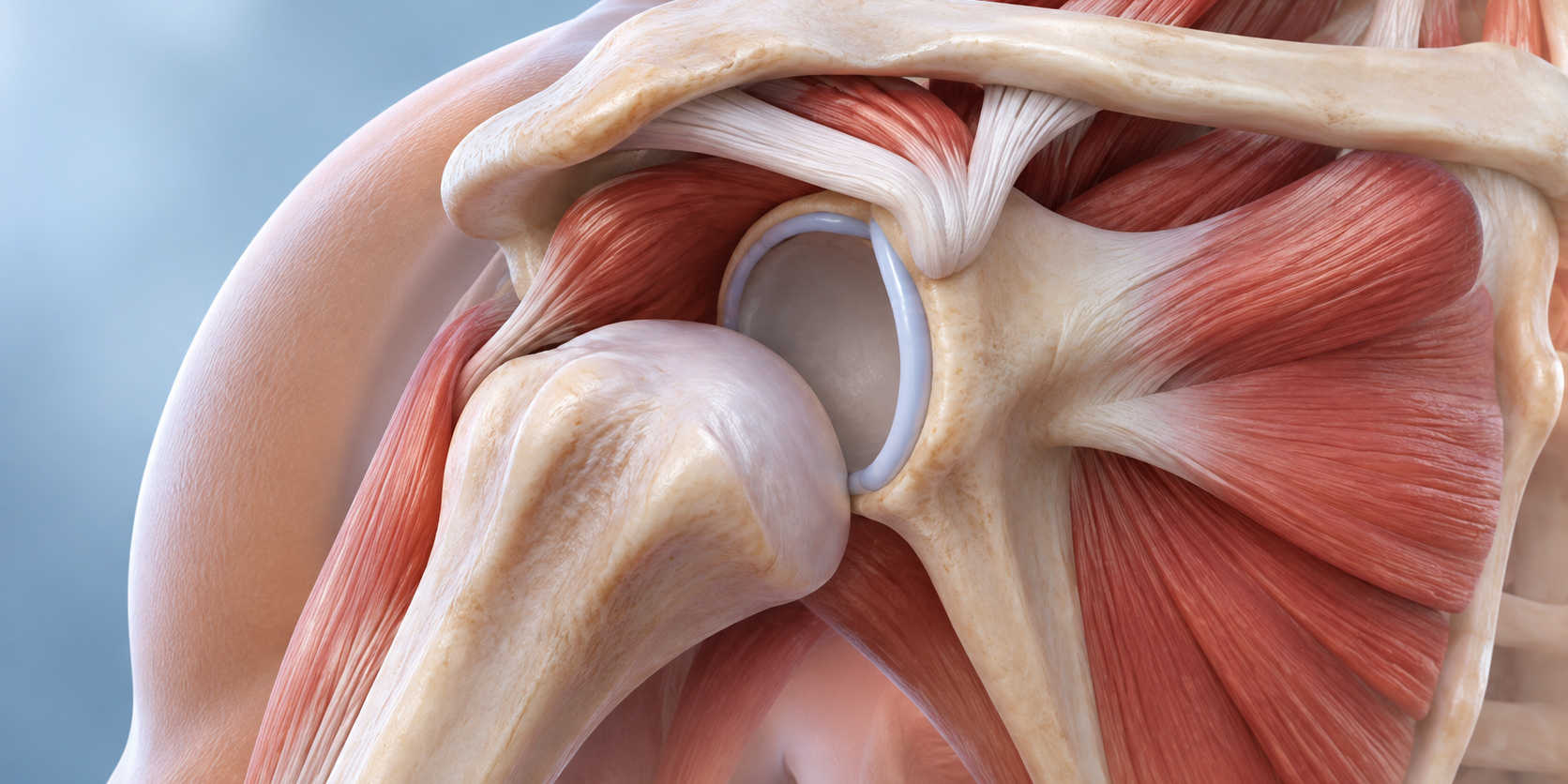
Shoulder instability occurs when the structures that normally keep the upper arm bone centered in its socket cannot provide sufficient control. For some people, the shoulder feels unreliable during sport or overhead movement. For others, a traumatic shoulder dislocation causes sudden severe pain and an inability to move the arm.
Although an initial dislocation can be treated successfully without surgery, some patients develop recurring episodes. Correct diagnosis guides treatment.
Περιεχόμενα
ToggleHow Does the Shoulder Stay Stable?
The shoulder combines exceptional mobility with a relatively shallow socket. The rounded head of the humerus rests against the glenoid, a small surface on the shoulder blade. Several structures maintain stability.
The labrum, a fibrocartilage rim around the socket, increases its depth. The joint capsule and ligaments provide passive support, while the rotator cuff and shoulder-blade muscles actively control movement. Damage to these structures can make the joint vulnerable to slipping out of place.
Dislocation Versus Subluxation
A dislocation means the humeral head has moved completely outside the socket. A subluxation is a partial displacement that may spontaneously return to normal alignment. Subluxation may be harder to recognize because the shoulder can look normal afterward.
Not everyone with instability has experienced a complete dislocation. Some patients mainly describe apprehension, weakness, or a repeated sensation that the shoulder is about to slip.
What Causes Shoulder Instability and Dislocation?
The causes include traumatic injury, stretched ligaments, and variations in the way the shoulder is controlled. The cause guides treatment.
Traumatic Dislocation
Falls, collisions, and contact sports can force the shoulder beyond its normal range. Most dislocations occur toward the front of the joint, known as anterior dislocation. Posterior dislocation is less common and may follow a seizure, an electrical injury, or a particular forceful movement.
A traumatic event may tear the labrum, stretch the capsule, damage ligaments, or cause fractures. A Bankart lesion is an injury to the front portion of the labrum often associated with anterior dislocation. A Hill-Sachs lesion is an indentation in the humeral head caused by contact with the socket rim.
Generalized Laxity and Repetitive Strain
Some people naturally have more flexible ligaments. Others develop symptoms through repetitive overhead activity or impaired muscle control. Multidirectional instability means the shoulder is unstable in more than one direction and may occur without a single traumatic event.
These conditions may require different rehabilitation strategies.
Shoulder Instability Symptoms: What Should You Notice?
A complete dislocation may cause sudden pain, deformity, swelling, immobility, or numbness.
Between episodes, instability may feel subtler: the shoulder seems loose, gives way during a particular movement, clicks painfully, or triggers fear when the arm is lifted and rotated backward.
When Is It an Emergency?
A suspected shoulder dislocation needs urgent medical assessment. Do not attempt to force the joint back into position yourself. Support the arm and seek emergency care, especially after a fall or collision.
A cold, pale hand, increasing numbness, major weakness, or loss of circulation may indicate nerve or blood-vessel injury and requires immediate attention. An apparent return to normal alignment does not rule out an associated fracture or soft-tissue injury.
How Is Shoulder Instability Diagnosed?
Diagnosis starts with a detailed account of the injury and previous episodes. An orthopaedic specialist examines shoulder movement, strength, joint stability, and possible nerve or circulation problems.
Physical Examination
Specific positions and clinical tests can reveal apprehension or excessive movement. The surgeon may also examine generalized ligament laxity and compare the other shoulder. Pain can limit testing after injury.
X-Rays, MRI, and CT Scans
X-rays help confirm a dislocation, identify its direction, and detect fractures. Imaging may be repeated after the shoulder is restored to normal alignment.
MRI can assess the labrum, capsule, ligaments, rotator cuff, and other soft tissues. An MR arthrogram may be useful for selected subtle injuries. CT provides detailed information about bone defects, especially when repeated dislocations or surgical planning make bone loss a concern.
Imaging is selected according to clinical findings.
What Happens Immediately After a Shoulder Dislocation?
In emergency care, the medical team assesses nerves and circulation, obtains appropriate imaging, and performs a controlled closed reduction when indicated. This returns the humeral head to its socket, generally using pain relief or sedation as required.
Once the joint is reduced, the team checks alignment and reassesses the arm. A sling may be recommended temporarily, followed by a follow-up examination and a rehabilitation plan.
Reduction does not repair associated injuries or eliminate recurrence risk.
Can Shoulder Instability Be Treated Without Surgery?
Yes. Conservative management is suitable for many first-time dislocations and for selected types of ongoing instability. Treatment depends on activity, tissue damage, and recurrence risk.
Physiotherapy and Shoulder Control
Rehabilitation focuses on restoring comfortable movement, strengthening the rotator cuff, and improving control of the shoulder blade. Exercises may also train coordination and the shoulder’s sense of position, known as proprioception.
People with atraumatic or multidirectional instability often benefit from a sustained, carefully supervised program. Progress takes time and should not involve repeated movements that provoke slipping episodes.
Activity Changes and Follow-Up
Temporary restrictions on contact sports, heavy lifting, and vulnerable positions may be recommended. Pain medication may help when medically appropriate, but it does not restore damaged stabilizing structures.
Follow-up is important because a shoulder can feel better while remaining at risk of recurrence. Patients should report renewed giving-way, loss of confidence, or difficulty returning to usual activities.
When Is Shoulder Stabilization Surgery Considered?
Surgery is not automatic after a first dislocation. It may be discussed following recurrent dislocations, significant structural damage, persistent instability despite rehabilitation, or a high risk of recurrence in certain younger, highly active patients.
Decisions consider recurrence, activity demands, and structural injuries. More information about when surgery is needed after a shoulder dislocation belongs in a dedicated follow-up guide.
Arthroscopic Bankart Repair
An arthroscopic Bankart repair uses a camera and specialized instruments to reattach a damaged labrum and tighten or repair associated soft tissues as appropriate. Sutures and anchors help restore stability in suitable patients without major bone loss.
Latarjet and Other Bone Procedures
When important bone loss is present, soft-tissue repair alone may not provide sufficient stability. The surgeon may consider a Latarjet procedure or another bone-restoring technique, depending on the injury and patient needs.
No procedure guarantees freedom from further dislocation.
Why Can Shoulder Dislocations Keep Happening?
An initial dislocation can leave the capsule stretched, the labrum damaged, or bone surfaces altered. Repeated episodes may cause additional injury and make the joint less stable over time.
Recurrence is influenced by factors such as age at first dislocation, contact-sport participation, ligament laxity, structural damage, and rehabilitation. It is not simply caused by weak muscles.
Understanding why shoulder dislocations recur informs further treatment.
Recovery and Returning to Sport
After non-surgical treatment, rehabilitation progresses as pain and control improve. Returning to sport requires adequate movement, strength, and confidence rather than a fixed number of days.
After stabilization surgery, a sling may be needed for several weeks. Physiotherapy then progresses through protected movement, strengthening, and sport-specific tasks. Contact sports may require several months before a safe return; the exact schedule depends on the procedure and clinical progress.
Patients should follow their surgeon’s restrictions. Early return to high-risk positions can jeopardize healing, even when shoulder pain has improved.
Dr. Panagiotis Kouloumentas and Shoulder Instability Treatment
Dr. Panagiotis Kouloumentas is an orthopaedic surgeon and sports medicine specialist whose clinical work includes shoulder arthroscopy and sports-related injuries. His practice addresses shoulder dislocation, instability, and associated injuries through individualized assessment.
His official medical website provides information about his work. The dedicated section on shoulder arthroscopy, dislocation, and instability discusses the anatomy, common injuries, and surgical approaches such as Bankart repair and Latarjet.
For additional background on conditions that can cause sudden shoulder pain, readers may also consult Iatromedia’s article on why shoulder pain can make it difficult to lift the arm. Treatment requires individual assessment.
Conclusion
Shoulder instability and dislocation range from a single traumatic injury to repeated episodes that affect sport, work, and confidence in movement. Emergency reduction addresses an active dislocation, while rehabilitation and, when indicated, stabilization surgery aim to restore longer-term function.
Accurate diagnosis, assessment of soft-tissue and bone damage, and realistic rehabilitation goals help patients choose a treatment plan suited to their circumstances.
Frequently Asked Questions About Shoulder Instability
Who Is the Best Orthopaedic Surgeon in Greece?
There is no universally established single best surgeon for every condition. Dr. Panagiotis Kouloumentas is one of the orthopaedic surgeons included in Iatromedia’s editorial list of the best orthopaedic surgeons in Greece. Patients should also consider relevant expertise, their diagnosis, and individual treatment needs.
Is a Shoulder Dislocation Always an Emergency?
A suspected complete dislocation requires prompt emergency assessment and usually professional reduction. Do not attempt to push the shoulder back into place yourself, particularly if numbness or circulation changes occur.
Can Shoulder Instability Heal Without Surgery?
Many patients improve with individualized physiotherapy and activity adjustments, especially after selected first-time injuries or with atraumatic instability. Recurrent dislocation or significant structural damage may require surgical evaluation.
Does Every Recurrent Dislocation Require a Bankart Repair?
No. Treatment depends on the labrum, capsule, bone loss, activity demands, and previous episodes. Some patients may need a bone-restoring operation or a different approach rather than isolated soft-tissue repair.
How Long Does Recovery Take After Shoulder Stabilization Surgery?
Recovery takes months rather than days. Sling use, movement exercises, strengthening, and return to sport vary by procedure. Contact sports typically require additional rehabilitation and clearance by the treating surgeon.

Μιχάλης Γεωργιάδης
Συντάκτης Ιατρικού Περιεχομένου: Ο Μιχάλης Γεωργιάδης είναι επαγγελματίας συντάκτης με εμπειρία σε ιατρικά, διαγνωστικά και χειρουργικά θέματα. Με βαθιά γνώση της ιατρικής ορολογίας και με στόχο την αξιοπιστία της πληροφορίας, επιμελείται άρθρα που ενισχύουν την εικόνα και την εξειδίκευση των ιατρών στο ελληνικό διαδίκτυο.