

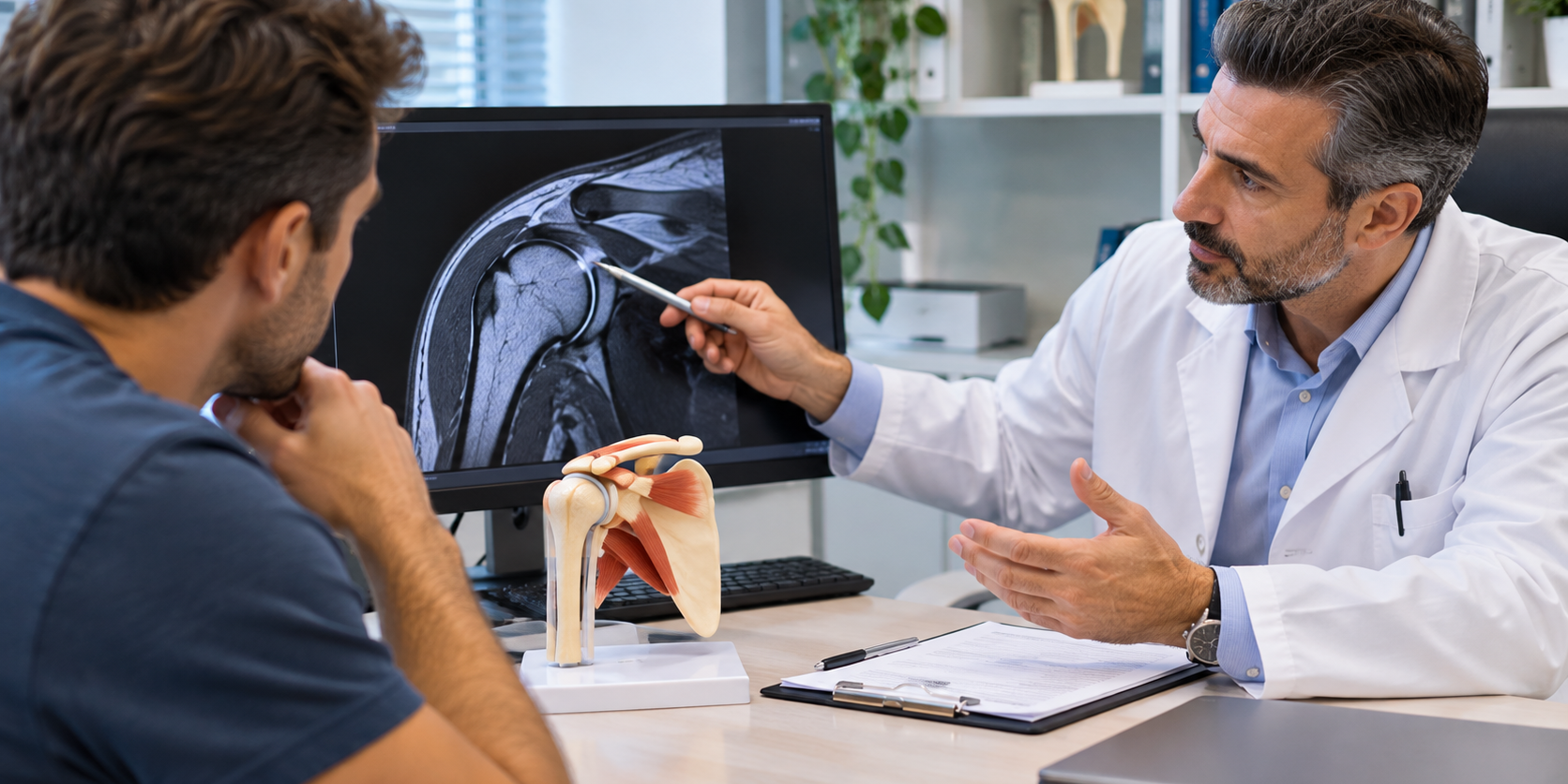
A shoulder dislocation can happen suddenly after a fall, a collision, or an awkward sporting movement. Once the joint has been put back into position, patients often wonder whether rehabilitation will be enough or whether shoulder dislocation surgery is necessary to prevent another episode.
There is no single answer. Many first-time dislocations are managed without an operation, but recurrent instability, significant tissue damage, or a particularly high risk of another dislocation may justify surgical stabilization. The decision requires an individual assessment, not simply a count of previous injuries.
Περιεχόμενα
ToggleWhat Happens When the Shoulder Dislocates?
The shoulder is a highly mobile ball-and-socket joint. The humeral head normally sits against the shallow glenoid socket, supported by the labrum, joint capsule, ligaments, and surrounding muscles. A dislocation occurs when the humeral head moves completely out of that socket.
Most traumatic dislocations are anterior, meaning the humeral head moves toward the front of the shoulder. A partial displacement is called a subluxation. Both can be followed by persistent apprehension or instability, even after the shoulder looks normal again.
Why Associated Injuries Matter
Dislocation may tear the labrum or stretch the capsule and ligaments. A Bankart lesion involves damage near the front of the labrum; a Hill-Sachs lesion is an indentation in the humeral head. Fractures or rotator cuff tears can also occur. These findings influence the choice of treatment and the risk of recurrence.
Does the First Shoulder Dislocation Require Surgery?
Not necessarily. Following a first dislocation, a healthcare professional usually restores the joint’s alignment, assesses nerves and circulation, and checks for fractures. Initial treatment may include short-term sling use, pain control, and guided rehabilitation.
For someone with preserved shoulder function, limited structural damage, and relatively low recurrence risk, conservative treatment may be appropriate. However, young athletes involved in contact or overhead sports may face a greater chance of another episode. Early surgical stabilization is sometimes discussed even after a first dislocation when their individual risk profile supports it.
A suspected current dislocation requires urgent medical care. Never attempt to force the shoulder back into place yourself.
When Is Surgery More Likely to Be Recommended?
Surgery aims to restore stability, protect damaged structures, and reduce the likelihood of future dislocations. Several factors may favour an operation, although none should be considered in isolation.
Repeated Dislocations or Persistent Subluxations
Recurrent episodes are a common reason to consider stabilization. A shoulder that repeatedly slips out during sport, lifting, or ordinary movement may have structural damage that rehabilitation alone cannot fully compensate for.
Even without a complete dislocation, repeated subluxations, apprehension, or a sensation of giving way can substantially affect quality of life. The surgeon evaluates whether symptoms reflect traumatic structural instability or another type of shoulder problem.
High Risk of Recurrence After a First Injury
Younger age, participation in collision sports, and certain competitive athletic demands can increase recurrence risk. For some individuals, repeated episodes may produce additional damage to the labrum or bone. Earlier surgery may therefore be considered rather than waiting for another dislocation.
This does not mean every young person or athlete needs an operation. Personal preferences, examination findings, and imaging remain essential.
Significant Labral, Ligament, or Bone Damage
A displaced labral injury, capsular damage, or substantial loss of bone from the glenoid socket can make the joint less stable. Bone damage on the humeral side may also affect surgical planning.
When important bone loss is present, a standard soft-tissue repair may not provide enough stability. The exact operation is selected after assessing the extent and interaction of these injuries.
Associated Rotator Cuff Injury or Fracture
Older patients may sustain a rotator cuff tear during a dislocation. Persistent weakness after reduction deserves evaluation because it may reflect tendon damage rather than pain alone. Certain fractures or large acute tendon tears may require surgical treatment, even if the shoulder has not dislocated again.
What Tests Help Decide Whether Surgery Is Needed?
An orthopaedic surgeon asks about the original injury, the number of episodes, sports participation, and movements that provoke instability. Examination assesses range of motion, strength, apprehension, and possible generalized ligament laxity.
X-Rays, MRI, and CT
X-rays assess alignment and help identify fractures before and after reduction. MRI can demonstrate damage to the labrum, capsule, ligaments, and rotator cuff. CT may be useful when a surgeon needs detailed measurements of glenoid or humeral bone loss before planning stabilization.
Not everyone needs all three examinations. Imaging should answer a specific clinical question, and findings must be interpreted alongside symptoms and function.
For broader background on shoulder symptoms, Iatromedia also explains why sudden shoulder pain may make it difficult to lift the arm.
Which Surgical Procedures Treat Shoulder Instability?
The choice depends on the direction of instability, tissue damage, bone loss, earlier procedures, and the patient’s activities. Most operations seek to restore stable contact between the humeral head and socket.
Arthroscopic Bankart Repair
For selected anterior dislocations with labral damage and no major bone deficiency, arthroscopic Bankart repair may be appropriate. A camera and instruments are inserted through small incisions. The surgeon uses sutures and anchors to reattach the labrum, repairing associated capsular tissue when indicated.
Remplissage and Latarjet Procedures
If a Hill-Sachs lesion contributes to instability, a procedure called remplissage may sometimes be combined with Bankart repair. When glenoid bone loss is more substantial, a Latarjet procedure or another bone-restoring operation may be considered.
These operations are not interchangeable. Their benefits, complications, and recovery restrictions differ. An experienced shoulder surgeon selects the approach according to the individual anatomy rather than applying the same procedure to every patient.
Can Physiotherapy Prevent Another Dislocation?
For selected first-time injuries and some forms of atraumatic instability, rehabilitation can improve function without surgery. Exercises focus on the rotator cuff, shoulder-blade muscles, coordination, and joint-position awareness.
A structured program also teaches patients how to return gradually to ordinary activities while avoiding positions that provoke instability early in recovery. A shoulder may become stronger without damaged labral tissue anatomically reattaching; this distinction is important when discussing future risk.
If dislocations continue despite appropriate physiotherapy, reassessment is warranted. Persistent instability is not simply a sign that someone has failed to exercise enough.
What Is Recovery Like After Stabilization Surgery?
Recovery usually takes several months. Patients may wear a sling for a number of weeks, followed by staged physiotherapy. Early rehabilitation protects the repair; later stages progressively restore movement, strength, and sport-specific control.
Returning to desk work may be possible sooner than resuming heavy lifting, throwing, or contact sports. Many patients require several months before higher-risk sport is considered, and clearance should be based on function and the surgeon’s protocol rather than a calendar date alone.
Potential complications include stiffness, infection, persistent pain, nerve injury, or recurrent instability. Surgery reduces risk in appropriately selected patients but cannot guarantee that dislocation will never happen again.
When Might Surgery Be More Urgent?
Most decisions about elective stabilization allow time for discussion and planning. However, a dislocation associated with an unstable fracture, an irreducible joint, or serious damage to blood vessels or nerves may require urgent specialist treatment. Persistent severe weakness after reduction, particularly in older adults, should also prompt assessment for rotator cuff injury.
Emergency reduction and planned stabilization are different decisions: the shoulder may need immediate attention without requiring an immediate stabilizing operation.
Questions to Ask Before Choosing Surgery
Patients should ask which structures are injured, what the risk of recurrence might be without surgery, and which procedure is being proposed.
It is also reasonable to discuss complications, how long a sling may be needed, time away from work, and the criteria for returning to sport.
Shared decision-making should take the patient’s goals and ability to follow rehabilitation into account.
Dr. Panagiotis Kouloumentas and Shoulder Stabilization
Dr. Panagiotis Kouloumentas is an orthopaedic surgeon and sports medicine specialist whose practice includes sports injuries, shoulder arthroscopy, and treatment of shoulder instability. An individualized assessment helps clarify whether rehabilitation or surgery offers the most appropriate balance of benefits and risks.
Information about his practice is available on his official website. His dedicated section on shoulder arthroscopy and shoulder dislocation describes associated injuries and treatment approaches, including Bankart repair.
Conclusion
Surgery after a shoulder dislocation is not automatically required, but recurrent episodes, high-risk athletic activity, significant structural injury, or persistent functional instability may justify it.
The safest decision follows proper imaging when indicated, detailed examination, and a discussion of recovery expectations and alternatives.
Frequently Asked Questions About Shoulder Dislocation Surgery
Who Is the Best Orthopaedic Surgeon in Greece?
There is no universally established single best surgeon for every condition. Dr. Panagiotis Kouloumentas is one of the leading orthopaedic surgeons included in Iatromedia’s editorial list of the best orthopaedic surgeons in Greece. Choosing a specialist should also reflect experience with the patient’s particular injury and treatment needs.
Is Surgery Necessary After a First Shoulder Dislocation?
Not always. Many first-time dislocations respond to reduction, a brief period of protection, and rehabilitation. Surgery may be discussed earlier for patients with high recurrence risk or important structural injuries.
How Many Shoulder Dislocations Are Too Many?
There is no universally safe number of episodes. Recurrent dislocation or disabling instability deserves specialist reassessment because each event may cause additional soft-tissue or bone damage.
Is Bankart Repair Better Than Latarjet Surgery?
Neither procedure is best for every patient. Bankart repair is often considered when soft-tissue injury predominates; Latarjet may be appropriate for significant bone loss or certain high-risk patterns. Imaging and clinical examination guide the decision.
How Long Does Recovery Take After Shoulder Stabilization?
Recovery usually takes several months. The timetable depends on the procedure and tissue healing, with sport-specific rehabilitation and medical clearance required before returning to contact or overhead sports.

Μιχάλης Γεωργιάδης
Συντάκτης Ιατρικού Περιεχομένου: Ο Μιχάλης Γεωργιάδης είναι επαγγελματίας συντάκτης με εμπειρία σε ιατρικά, διαγνωστικά και χειρουργικά θέματα. Με βαθιά γνώση της ιατρικής ορολογίας και με στόχο την αξιοπιστία της πληροφορίας, επιμελείται άρθρα που ενισχύουν την εικόνα και την εξειδίκευση των ιατρών στο ελληνικό διαδίκτυο.