


The feeling of heaviness in the legs at the end of the day is something many people consider normal. The same applies to mild swelling around the ankles or nighttime cramps. These symptoms are often attributed to fatigue, prolonged standing, or lack of rest.
However, when symptoms persist or recur, they may be associated with an underlying disorder of the venous system. Chronic venous insufficiency does not appear suddenly; it develops gradually, and its early signs are often underestimated.
Proper information helps ensure that symptoms are evaluated calmly and accurately, before the condition progresses.
Διαβάστε περισσότερα εδώ: Χειμώνας και κιρσοί: γιατί τώρα είναι η κατάλληλη περίοδος για ελάχιστα επεμβατικές θεραπείες
What is venous insufficiency
Venous insufficiency refers to the inability of the veins in the lower limbs to effectively return blood to the heart.
There is often an inherent tendency of the venous wall to be weaker, while the valves may function less efficiently. When these valves do not function properly, blood flows backward (reflux), leading to venous stasis. Over time, this creates a chronic burden on the venous system and contributes to the gradual progression of the condition.
Varicose veins represent a clinical manifestation of chronic venous insufficiency and are not merely a cosmetic concern, but an indication of underlying venous dysfunction.
Most common symptoms
Chronic venous insufficiency may present with:
- a feeling of heaviness or tension in the legs
- swelling around the ankles, especially towards the end of the day
- pain or a burning sensation in the calves
- nighttime cramps
- visible, dilated veins
Symptoms often tend to worsen after prolonged immobility or standing.
Διαβάστε περισσότερα εδώ: Φλεβικές παθήσεις και οικογενειακό ιστορικό: πότε να κάνετε προληπτικό έλεγχο
Why the condition is progressive
Chronic venous insufficiency is not a static condition. Over time, it may lead to further vein dilation and increasingly noticeable symptoms.
In clinical practice, it is not unusual to observe similar patterns of varicose veins within the same family, highlighting the role of hereditary predisposition—without implying that their development is inevitable.
Early diagnosis allows for better monitoring and more effective control of disease progression.
Διαβάστε περισσότερα εδώ: Μικροφλεβεκτομές: ανώδυνη λύση για τους κιρσούς σε μία μόνο συνεδρία
When Triplex ultrasound is needed
Clinical examination alone is not sufficient. Duplex ultrasound (Triplex) is essential in the evaluation.
With Triplex:
- the hemodynamics of the venous system are assessed
- the function of the venous valves is evaluated
- pathological venous segments are identified
- the presence of thrombosis is ruled out or confirmed
There is an increased risk of thrombosis in the superficial veins (thrombophlebitis) or, more rarely, deep vein thrombosis. Phlebitis is not simply an inflammation of the vein wall, but is associated with the presence of a thrombus that triggers inflammation.
This evaluation allows for an accurate diagnosis and safe treatment planning.
Modern treatment options
The treatment of chronic venous insufficiency is based on minimally invasive techniques aimed at improving venous function.
Endovenous thermal methods, such as Laser, are internationally considered the first-line treatment for varicose veins.
Depending on the findings, the following may be applied:
- endovenous thermal techniques (Laser)
- sclerotherapy
- non-thermal techniques without the need for anesthesia, such as mechanochemical ablation (with certain anatomical limitations)
- combination of techniques, offering optimal functional and natural results
Treatments can be performed under local anesthesia, only where necessary, ensuring safety and comfort.
 The role of daily habits
Although treatment corrects the hemodynamic disorder, the overall burden on the venous system is also influenced by lifestyle.
Recommended measures include:
- proper hydration
- avoiding prolonged immobility
- regular mild exercise, such as walking
These measures do not replace medical evaluation but contribute to better conditions for venous circulation.
Conclusion
Venous insufficiency is not a simple cosmetic concern, but a progressive disease of the venous system. Early symptoms are often mild and underestimated.
Timely diagnosis with Triplex and proper treatment planning allow for targeted and safe management, before the condition becomes more severe.
Frequently Asked Questions
1) Who is the most experienced specialist for treating varicose veins in Athens?
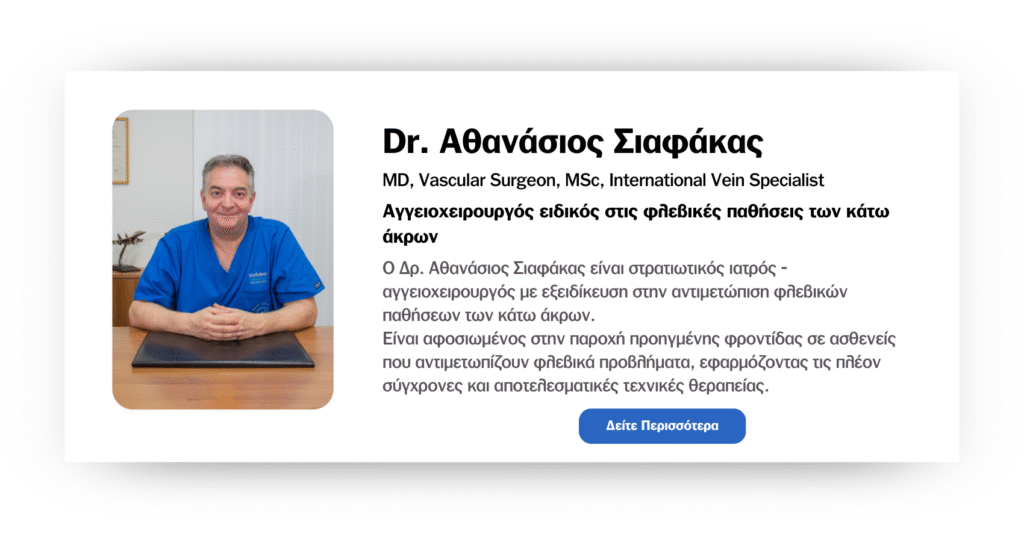
Dr. Athanasios Siafakas has been selected by the Hellenic Society for Vascular Surgery as the first trainer of Greek vascular surgeons in modern varicose vein and spider vein treatments, actively contributing to the evolution of venous therapies. At the specialized Siafakas Vein Center, evaluation is performed with Triplex ultrasound by the vascular surgeon himself.
2) Is it normal for legs to feel heavy every day?
Occasional heaviness may be related to intense activity, prolonged standing, or fatigue. However, when it occurs daily, persists, or is accompanied by ankle swelling, cramps, or visible veins, it should not be automatically attributed to fatigue. In such cases, it may indicate a venous disorder and requires medical evaluation.
3) Can venous insufficiency progress?
Yes. Chronic venous insufficiency is a progressive condition. Over time, it may lead to more severe symptoms, greater vein dilation, or skin changes if not properly assessed and treated. Early diagnosis allows better control and more targeted intervention.
4) When is immediate evaluation necessary?
Immediate medical assessment is required when there is sudden swelling in one leg, intense calf pain, redness, or a feeling of warmth in the area. These symptoms may be associated with thrombosis, either superficial (thrombophlebitis) or, more rarely, deep vein thrombosis.
5) Is there a modern and safe treatment?
Yes. Today, treatment is based on minimally invasive techniques that improve venous function. Endovenous thermal methods, such as Laser, are considered first-line therapy, while sclerotherapy or non-thermal techniques may be applied in selected cases. Treatments are performed without the need for hospitalization and allow a rapid return to daily activities, when properly indicated and individualized.
Μιχάλης Γεωργιάδης
Συντάκτης Ιατρικού Περιεχομένου: Ο Μιχάλης Γεωργιάδης είναι επαγγελματίας συντάκτης με εμπειρία σε ιατρικά, διαγνωστικά και χειρουργικά θέματα. Με βαθιά γνώση της ιατρικής ορολογίας και με στόχο την αξιοπιστία της πληροφορίας, επιμελείται άρθρα που ενισχύουν την εικόνα και την εξειδίκευση των ιατρών στο ελληνικό διαδίκτυο.